A well-formatted, strategically planned website footer can work wonders for your lead generation and visitor retention. Here we explain how to get the most out of your website footer.
Website footers are a brilliant way to display important information and direct your readers intentionally around your site – however, they’re often an overlooked feature, leading to major missed opportunities.
The truth is that a website footer is a powerful tool for generating leads, keeping visitors on your site and sending them in the direction that you want them to go. So yes, it very much matters!
Why does your website footer matter? Your website footer is a great place to store technical or legal information, add credibility, drive newsletter sign ups, map out your site and boost your SEO. It’s intention is to help your visitors.
But, what makes a good website footer and what does it actually need to include? Read on to find out.
What is a website footer?
Let’s start by explaining what a website footer is.
Most web pages have a similar anatomy. You can expect a header – which will be at the top of the site pages – with a logo and navigation menu. Below this, you’ll find the body of a website: this is where the main content is stored. Finally, at the very bottom, is your website footer.
While a website doesn’t technically need a footer to function, it’s an important part of your website structure.
Does a website footer REALLY matter?
Yes, yes and yes again!
You may have heard that readers rarely scroll past the fold of a website, but research has suggested that this isn’t necessarily the case. In fact, a study by Chartbeat – which looked at 25 million website visits – found that visitors scroll down THOUSANDS of pixels. So, that footer at the bottom of your page? It isn’t too far for them to discover.
Another study by Smart Insights showed a 16% increase in revenue per customer when they tested a more easily navigable footer. Other brands have reported a 50% improvement in conversions when they optimised their website footer with clear goals in mind.
The numbers speak for themselves – website footers can seriously improve your business… It’s time to give them the attention they deserve!
What should a website footer include?
Now you know that your website NEEDS a footer – what should you put in it?
There are many things that can be included in a website footer, including:
Call to action (CTA) – You should include a CTA in every piece of content you produce, not least your website footer. Do you want people to schedule a call? To sign up to a service? To take advantage of a discount? Decide which is the most important action and weave it into your footer.
Contact details – This could be in the form of an actual contact form, or your email address / phone number / address. Whatever you choose, make it clear how people can connect with you.
Social media – Speaking of connection, be sure to add in your social media links or even a snippet of one of your feeds. Use your footer as an opportunity to expand your web of connection and communication.
Newsletter sign ups – Your footer is a great place to remind people of your newsletter and encourage signups.
Copyright – The year and copyright symbol will help (although isn’t a guaranteed way to) avoid website plagiarism.
Sitemap – Although these links may not be clicked (as most people will use your header navigation bar to find their way around your site) your sitemap is a great method of boosting your SEO.
Privacy policy, terms of use and any other legal documents – You may not want to feature this in your header navigation, but they are still a crucial part of your site.
Site search tool – If a visitor can’t find what they need in your header or footer, then they’re going to want a site search tool. Pop one in your website footer to make sure your visitors can always reach the place they’re looking for.
Awards, memberships and associations – These small logos can be a huge confidence booster for your videos.
Latest articles – If you don’t have a section in the body of your website that features your latest articles and blogs, your website footer can be a useful place to slot them.
What makes a good website footer? | Case Studies.
Your website footer could well be the last thing that a visitor sees before leaving your website – it’s important that you make it count.
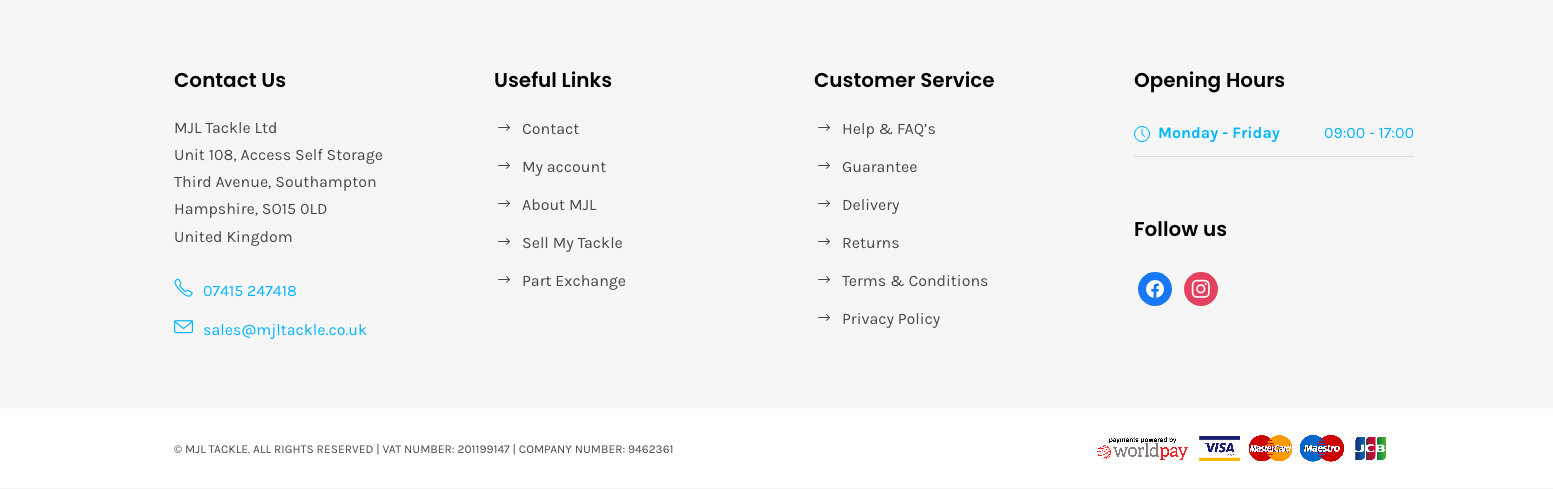
Below is an example of a footer that the Littlebigbox team has been working on for a new website project.
Case study #1 – MJL Tackle
We love this website footer because it’s been used to its full advantage.
We chose to feature:
Contact information (so that customers could quickly get in touch with the business)
Links to helpful pages (to gently nudge readers in the right direction)
Opening hours (allowing customers to easily see the hours the shop is open without having to hunt through the pages)
Social media links (enabling easy access to all of the brand’s marketing platforms)
Payment icons (making it clear to customers how they can pay and making the entire process easy and transparent)
It was also a priority for us to make sure that although the footer held a lot of information, it didn’t look clustered. To achieve this, we designed the footer with plenty of space and in clear blocks, drawing the eye gradually from the contact information (the most important part for this business!) right through to the payment options.
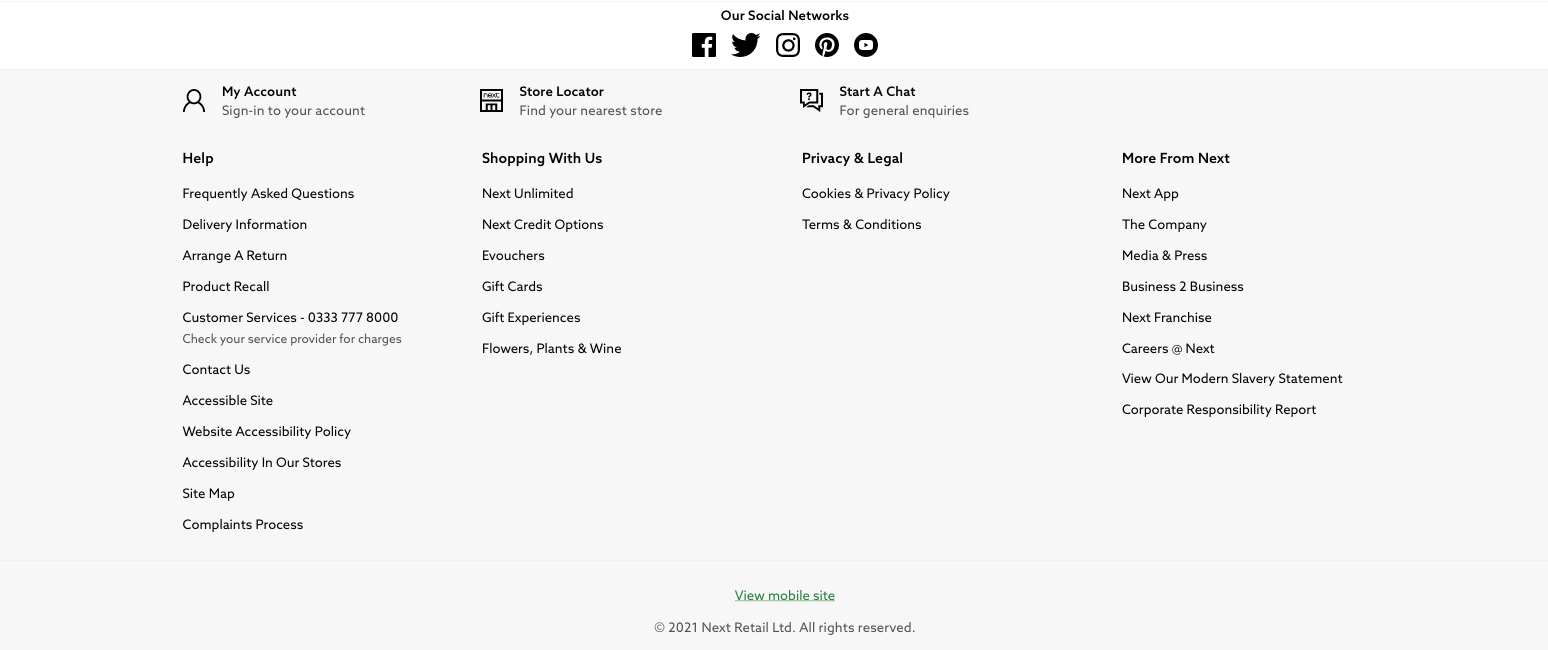
Case study #2 – Next
Next offers another example of an intelligent website footer. This footer works really well, as it has a long list of useful links to various sections of the website; this is important, as they have a huge website with many areas to navigate. This runs the risk of overwhelming the reader, but Next has structured the list in an easy to absorb way.
They have also included quick links along the top of the footer with icons, adding more of a focus for customers and quick access.
Finally, they have included their social icons, widening their reach and clearly showing how customers can connect with them in different spaces.
In summary…
Just because your website footer exists at the bottom of your page, it shouldn’t be at the bottom of your agenda!
Spend some time looking at your footer to decide whether it:
Is helping you reach your goals
Is giving customers what they need
Is enhancing your SEO
Need a helping hand? Get in touch with the Littlebigbox team for a chat.
If you’ve been looking at your website recently and wondering whether it’s time to start again, you’re certainly not alone. It’s a question I hear regularly from business owners. Sometimes…
First impressions matter more than you think When someone lands on your website, a lot happens in just a few seconds. Understanding what happens when someone visits a website can…
February is often about relationships. And when it comes to your business, your website is usually the very first interaction someone has with you. Understanding how to build trust on…